
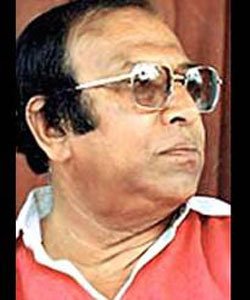
Name: Pradip Kumar Banerjee
Born: 23 June 1936, Jalpaiguri, West Bengal
Died: 20 March 2020, Kolkata
State: West Bengal
Sport: Football
Early life
Pradip Kumar Banerjee, known throughout Indian football as PK Banerjee, was born on 23 June 1936 in Jalpaiguri, West Bengal. He studied at Jalpaiguri Zilla School before completing his schooling in Jamshedpur, and was still only fifteen when he played right-winger for Bihar in the Santosh Trophy, an early sign of the talent that would take him to the top of Indian football. He moved to Kolkata in 1954 and joined Mohun Bagan, before later turning out for Eastern Railway, where he scored freely and established himself as one of the most feared wingers in domestic football.
Part of a famous forward line
Banerjee formed one-third of what became known as the holy trinity of Indian football, alongside Chuni Goswami and Tulsidas Balaram, a forward line still spoken of as the finest India ever fielded. He became an Olympian at twenty, part of the Indian team that reached the semi-finals at the 1956 Melbourne Olympics, considered one of the greatest results in the history of Indian football. He went on to represent India at the 1958, 1962 and 1966 Asian Games, winning gold at Jakarta in 1962, and captained the side at the 1960 Rome Olympics, where he scored the equaliser in a 1-1 draw against France that remains one of Indian football’s most celebrated Olympic moments.
Retirement and a switch to coaching
Recurring injuries brought Banerjee’s playing career to an end in 1967, after which he trained as a coach under Dettmar Cramer in Japan. He took charge of East Bengal from 1970, guiding the club through one of its most successful periods, including six consecutive Calcutta League titles, and later coached Mohun Bagan to a triple crown of the IFA Shield, Rovers Cup and Durand Cup in 1976. The following year, his Mohun Bagan side held Pele’s New York Cosmos to a 2-2 draw in an exhibition match that drew enormous crowds to Kolkata, one of the biggest football occasions the city had seen.
Coaching India for over a decade
Banerjee coached the Indian national team across various spells between 1972 and 1986, a period during which Indian football struggled to keep pace with the rising standards elsewhere in Asia, though his sides remained competitive on their day and continued to produce results that kept the country in touch with the region’s better teams. He later served as technical director of the Tata Football Academy in Jamshedpur from 1991 to 1997, passing on his experience to a new generation of players, and continued to be closely associated with football administration and coaching in Bengal for the rest of his life, remaining a familiar and much-loved presence at matches in Kolkata well into his eighties.
Recognition and death
Banerjee was among the first recipients of the Arjuna Award when it was instituted in 1961, and received the Padma Shri in 1990. FIFA later named him Indian Footballer of the 20th Century and, in 2004, presented him with the FIFA Order of Merit, one of the game’s highest honours. He is also the only Indian footballer to have received the International Fair Play Award from the Olympic Committee. He died in Kolkata on 20 March 2020, at the age of 83, after a period of declining health; his brother, Prasun Banerjee, also captained the Indian football team and went on to a career in politics.
Achievements and awards
Gold medallist, 1962 Asian Games, Jakarta; semi-finalist, 1956 Melbourne Olympics; captain, 1960 Rome Olympics; part of Indian football’s “holy trinity” forward line; Arjuna Award, 1961; Padma Shri, 1990; FIFA Order of Merit, 2004; FIFA Indian Footballer of the 20th Century; International Fair Play Award, Olympic Committee.


